
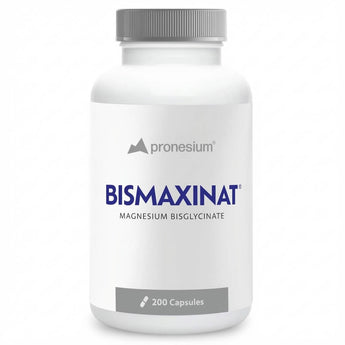


BISMAXINAT® - Magnesium Glycinate
 X-ray analysismeasured at the ESRF, Grenoble
BISMAXINAT® Magnesiumglycinat
We had our magnesium X-rayed at the ESRF in Grenoble, one of the world’s most powerful X-ray sources. This shows what’s really inside.
You can find older batches on TRACE PRECISION.
No free glycine.
 Measured at the ESRF in Grenoble,
one of the world’s most powerful X-ray sources.
Every crystalline substance scatters X-rays in its own pattern, like a fingerprint. Genuine bisglycinate has a different fingerprint from a blend of oxide and glycine.
We check whether the fingerprint of genuine magnesium bisglycinate is fully present.
- Magnesium bisglycinate
- Main lines in the fingerprint
checked against the published crystal structure
Magnesium oxide is the cheapest form of magnesium. Added to a blend, it pushes up the magnesium content on the label, but it is poorly absorbed.
We look specifically for the fingerprints of cheap fillers.
- Magnesium oxide
- Magnesium hydroxide
- Magnesium carbonate
- Free glycine
Detection limit 0.2–0.7% depending on the substance
This is the real measured curve of our batch. Tap “What a blend would look like” above to compare.
Grenoble,France
Measured at the ESRF, evaluated by pronesium against published reference structures; the evaluation is not accredited. The results apply to the measured sample of this batch.

BISMAXINAT® Magnesiumglycinat
pronesium has every batch tested by AGROLAB, an independent, accredited food laboratory.
You can find older batches on TRACE PRECISION.
Food supplements may contain up to 7.9 µg of lead per daily dose. Ours contains less than a sixth of that.
Heavy metals such as lead occur naturally and get into many foods via soil and water. That’s why we test every batch.
- Lead
- Cadmium
- Mercury
- Arsenic
per daily dose (3 capsules), tested against EU maximum levels
We check that every batch is microbiologically sound.
- Total viable countNot detectable
- E. coliNot detectable
- YeastsNot detectable
- MouldsNot detectable
tested to DIN EN ISO
We check whether there really is as much magnesium inside as it says on the jar.
- Magnesium
per daily dose (3 capsules), checked against the amount stated on the jar

The results apply to the tested sample of this batch, as reported by the laboratory. Values per daily dose converted from the lab values in mg/kg (3 capsules = 2,65 g). AGROLAB LUFA GmbH, Kiel · Analysis no. 294575.
 TRACE PRECISIONReg.-Nr. 26-1021
BISMAXINAT® Magnesiumglycinat
For every batch, we disclose where each ingredient comes from. Every stage is backed by documents and checked by TRACE PRECISION.
You can find older batches on TRACE PRECISION.
“Made in Germany” often just means the last step happened there. Here you can see every stage individually, with its country.
- Raw material Germany Austria
- Capsule shell
- Filling Germany
- Jar & label Germany
every stage backed by a document
Filling takes place at a certified food business in Germany.
- GMP
- IFS Food
- HACCP
- DIN EN ISO 9001
Certificates held by TRACE PRECISION
What the raw material manufacturers confirm by certificate.
- Fully chelated
- GMO-freeConfirmed
- Allergen-freeConfirmed
- Halal & KosherConfirmed
according to the raw material manufacturers’ certificates
TRACE PRECISIONReg.-Nr. 26-1021
Information applies to the selected batch. The origin of the capsule shell may change from batch to batch because the manufacturer operates several plants.


Couldn't load pickup availability
Effect
Contributes to normal function of the nervous system, muscles, psychological function, normal energy metabolism, and normal bones
Dosage: 3 capsules = 240 mg magnesium
We recommend a daily intake of 240 mg of magnesium. Simply take 3 BISMAXINAT capsules together (e.g., 30 minutes before bedtime) or at different times of the day with a glass of water.
Why 240 mg? The German Federal Institute for Risk Assessment (BfR) recommends no more than 250 mg of magnesium per day from food supplements. BISMAXINAT stays just below that at 240 mg: as much as makes sense, no more.
Ingredients
Magnesium bisglycinate, capsule shell: Hydroxypropylmethylcellulose
Ingredients per daily dose (3 capsules):
240 mg magnesium from 2286 mg magnesium bisglycinate.
Lab & transparency

BISMAXINAT® is verified by TRACE PRECISION®
Common claims like “Made in Germany” often refer to just a single processing step; raw materials are sourced worldwide and rarely fully documented in origin, composition and quality. TRACE PRECISION® requires evidence at every stage and makes every batch publicly traceable.
View on TRACE PRECISION®
The Uniqueness of Magnesium Bisglycinate
Bioavailability and Tolerability
Magnesium glycinate is characterized by its excellent bioavailability, which means that your body can absorb and utilize it efficiently. This form of magnesium is particularly well-tolerated and ideal for regular intake.
Advantages of the Binding Partner
The amino acid complex glycine as a binding partner ensures that the magnesium is released gently and effectively. This supports a consistent supply without unpleasant side effects. As a neurotransmitter, glycine plays an important role in the central nervous system and is involved in many other crucial processes. Together, glycine and magnesium form a dream team, as magnesium contributes to the normal functioning of the nervous system.
Fully chelated for maximum effect
Only fully chelated magnesium bisglycinate guarantees that all magnesium ions are optimally bound. This is crucial to realize the aforementioned benefits and ensure consistently high quality.

The Dark Side of the Market: Impure Magnesium Supplements
Adulterated Product Formulations
Nearly all magnesium bisglycinate preparations available on the market (even from the largest brands) are not pure, but diluted, buffered, or consist of loose mixtures. This deception is concealed in the product declarations.
Reasons for the Adulteration
- Theoretical and actual maximum content: Pure magnesium bisglycinate can chemically contain a maximum of 14.10% magnesium – but only as a completely anhydrous material. In trade, the compound exists as a hydrate, and the crystal water adds to the weight: commercially available material therefore reaches 10 to 11.7%.
- High Dosage and Costs: In times when quantity rather than quality (as long as it's highly dosed) counts without checking its meaningfulness, this content is too low, and the pure raw material is too expensive. Therefore, manufacturers resort to bulking agents to reduce costs and increase the content.
Problems for You as a Consumer
- Unclear Ingredients: You do not know exactly how much pure bisglycinate is contained and how high the proportion of inferior components like cheap oxide is.
- Difficulty in Quality Assessment: Without transparent information, it is almost impossible for you to assess the quality of the bisglycinate.
- Safety Risks: Adulterated or inferior products can cause unwanted side effects and offer no guarantee for the purity and safety of the ingredients.

How to identify a pure product
Work it out for yourself
The simplest starting point is the magnesium content. Everything you need for this is on the pack: the amount of magnesium and the amount of the compound per daily dose. Our calculator directly below this section does this for you, without scales and without a lab.
How to interpret the magnesium content
- Up to around 11.7%: the range for commercially available raw materials. The driest common form, the dihydrate, reaches 11.66%.
- 11.7 to 14.1%: chemically possible, but requires a nearly anhydrous raw material, which is rare on the market. Anyone declaring such a value would have had to source this raw material specifically – and should be able to prove it.
- Above 14.1%: chemically impossible. The excess must come from another, cheaper form of magnesium – the product is demonstrably adulterated.
Conversely, a value below 14.1% still doesn't prove purity: the same figure also results from a simple mixture of magnesium salt and glycine. Whether it is genuinely a chelate is shown only by a structural analysis.
Our promise: 100% chelated and fully reacted
We provide exactly this structural analysis: with BISMAXINAT®, we prove the full purity and complete chelation using X-ray powder diffraction (XRD), measured at the ESRF in Grenoble, one of the most powerful X-ray sources in the world. With 10.5% magnesium, BISMAXINAT sits right in the middle of the range for genuine commercial goods.
The measurement curve shows the final structure of our magnesium bisglycinate: no oxide, no hydroxide, no free glycine. You can view the curve yourself above under "View X-ray analysis".
What makes BISMAXINAT® so special?
The best magnesium glycinate on the market? Compare and decide for yourself!


Answers to the most important questions
FAQ
When should magnesium glycinate be taken?
Magnesium glycinate can be taken at any time with sufficient water. In general, it is recommended to spread the intake throughout the day. However, taking the entire daily dose in the evening is also possible.
How much magnesium glycinate should you take?
The nutrient reference value, which also forms the basis for the percentage information on product labels, for the recommended daily magnesium intake for adults is 375 mg per day.
So should I take 375 mg of magnesium or more through dietary supplements every day?
No, because the nutrient reference value takes into account the total intake, meaning both through daily food and supplementation. Magnesium is found in many foods, so it is unlikely that a relevant amount is not absorbed through a normal diet.
However, it is correct that depending on life circumstances, there may be an increased need for magnesium, for example, due to increased physical activity or stress.
The Federal Institute for Risk Assessment (BfR) recommends a maximum daily dose of 250 mg of magnesium from dietary supplements.
The daily dose of our magnesium compounds ranges between 240 mg and 300 mg of magnesium.
What sets BISMAXINAT apart from other products?
Our magnesium bisglycinate is proven to be 100% chelated and, unlike most products on the market, is neither diluted with cheaper forms of magnesium nor loosely mixed.
What does 100% chelated mean?
100% chelated means that every magnesium ion is fully bound to the amino acid glycine. This binding improves the absorption and bioavailability of magnesium in the body, making it more effectively utilized.
Why does BISMAXINAT contain less magnesium than other products?
BISMAXINAT contains 10.5% magnesium. That's exactly the range that genuine, commercially available magnesium bisglycinate reaches: the compound exists in trade as a hydrate, the crystal water adds to the weight, so it reaches 10 to 11.7%. Products with noticeably higher values usually achieve this by adding cheaper forms of magnesium such as oxide.
This high purity ensures better bioavailability, allowing the body to absorb the magnesium more efficiently.
Quality over quantity – because your body deserves the best.
What ingredients does BISMAXINAT contain?
BISMAXINAT contains exclusively 100% magnesium bisglycinate and no additional excipients. The capsule shell is made from hydroxypropylmethylcellulose (HPMC), without carrageenan and PEG.
Ingredients per daily dose (3 capsules):
240 mg magnesium from 2,286 mg magnesium bisglycinate.
Are there scientific studies?
Due to legal requirements, we are only permitted to make limited statements about the effects of individual ingredients. These studies examine the properties of magnesium glycinate and glycine:
Schuette, Sally A. et al. “Bioavailability of magnesium diglycinate vs magnesium oxide in patients with ileal resection.”JPEN. Journal of Parenteral and Enteral Nutrition18 5 (1994): 430-5 .
DiSilvestro, R.A., Joseph, E., Starkoff, B.E. and Devor, S.T. (2013), Magnesium Glycinate Supplementation in Bariatric Surgery Patients and Physically Fit Young Adults. The FASEB Journal, 27: lb291-lb291.
Bannai, Makoto et al. “The Effects of Glycine on Subjective Daytime Performance in Partially Sleep-Restricted Healthy Volunteers.”Frontiers in Neurology3 (2012): n. pag.
Wittemans, Laura B L et al. “Assessing the causal association of glycine with risk of cardio-metabolic diseases.”Nature Communications10 (2019): n. pag.
Malate in the morning, bisglycinate in the evening.
Optimal magnesium supply for the entire day. Discover the DAY & NIGHT PACKAGES.


Perfect combination - smart savings!
Get our perfectly matched product bundles and save 23% compared to individual purchases!


Related articles for the product

Magnesium glycinate and bisglycinate: benefits, side effects and the difference
Magnesium glycinate and magnesium bisglycinate are the same compound: magnesium bound to two molecules of the amino acid glycine. This form is considered well tolerated, is absorbed better than magnesium...
More about magnesium glycinate
What is Magnesium Glycinate and why is BISMAXINAT® the best choice?
Magnesium glycinate is one of the highest quality forms of magnesium. This compound of magnesium and the amino acid glycine has particularly high bioavailability, allowing the body to absorb and utilize it efficiently. Unlike many products on the market, BISMAXINAT® guarantees that it is 100% chelated. This means that the magnesium is optimally and stably bound to glycine and not diluted with inferior forms of magnesium.
The chelation makes BISMAXINAT® exceptionally well-tolerated and effective. Compared to conventional preparations, it is free from additives of unclear origin and comes from a renowned raw material manufacturer that adheres to the highest quality standards. This purity and transparency are crucial for magnesium bisglycinate to unleash its full potential.
Magnesium Glycinate Effects: Why BISMAXINAT® is particularly effective
The effects of magnesium glycinate are well-documented and based on the properties of magnesium and glycine. Magnesium is essential for over 300 enzymatic processes in the body, including the regulation of energy metabolism as well as muscle and nerve function. In combination with glycine, it has additional properties that can have positive effects.
A comparison between magnesium glycinate and magnesium citrate can be helpful in determining the appropriate magnesium compound. While magnesium citrate may have a laxative effect, magnesium glycinate is better tolerated and offers further advantages due to its binding partner.
What is the difference between magnesium and magnesium glycinate?
Magnesium glycinate is a specific compound in which magnesium is bound to the amino acid glycine. This bond improves bioavailability, meaning that magnesium glycinate is absorbed more efficiently by the body and is better tolerated than pure magnesium or other magnesium salts.
A common term related to magnesium glycinate is also magnesium bisglycinate. These two terms are often used synonymously because they describe the same compound. The difference lies merely in the spelling or marketing of the product. Magnesium bisglycinate emphasizes that two glycine molecules are bound to a magnesium ion.
Magnesium Glycinate from the pharmacy: When is it worth buying locally?
BISMAXINAT offers a tested quality that is equally appreciated in local pharmacies and online pharmacies. In the pharmacy, customers benefit from expert advice and the opportunity to ask questions about dosage or possible side effects.
Another advantage of the pharmacy is that products from well-known brands are often available. These products impress with high purity, optimal dosage, and additional safety tests.
Magnesium glycinate is mainly available in capsule form and only rarely as a powder, as the taste is often perceived as very sweet and sometimes fishy due to the glycine.
Magnesium Glycinate Side Effects: What to Watch Out For?
Although Magnesium Glycinate is considered one of the most tolerable forms of magnesium, side effects can occur in cases of overdose or individual intolerances. The most common side effects include mild stomach discomfort, nausea, or diarrhea. However, these usually only occur with extremely high dosages.
A major advantage of Magnesium Glycinate is that it has less of a laxative effect compared to Magnesium Citrate. This makes it ideal for individuals with sensitive stomachs. Nevertheless, the recommended daily dose should not be exceeded.
Frequently, a reason for side effects is the addition of inorganic compounds like Magnesium Oxide, which are not well tolerated by many people.
Magnesium Glycinate Test Winner: What to Consider When Buying?
When selecting a suitable Magnesium Glycinate product, quality, price, and personal needs play a crucial role. Test winners in independent studies often stand out due to their purity, bioavailability, and effectiveness. It is important to ensure that the product is free from unnecessary additives such as colorants or preservatives.
In comparison to conventional supplements, which often perform poorly in independent product tests, BISMAXINAT impresses with its purity and efficiency.
Whether in the pharmacy or online – with BISMAXINAT, a high-quality and well-tolerated magnesium compound is chosen.

