
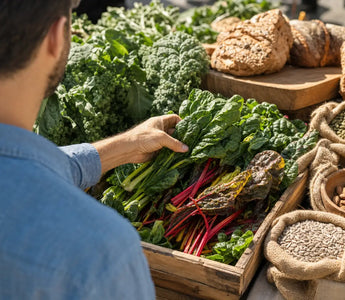
In short: Seeds and nuts, cocoa, wholegrains, pulses and dark leafy greens give you the most magnesium. Top of the list per serving is a handful of pumpkin seeds with around 180 mg, more than half a woman's daily need. Magnesium-rich mineral water counts too. Choosing wholegrain over white flour, sourdough bread and cooking with less water all help you get more out of your food.
Key points
- The strongest sources: pumpkin seeds, sunflower seeds, cashews, almonds, cocoa, oats, beans, spinach and chard.
- Serving size matters: cocoa powder is high in magnesium per 100g, but one teaspoon only gives you around 25 mg. A plate of cooked spinach gives you over 130 mg.
- Well absorbed: studies show magnesium from bread, almonds and mineral water is taken up about as well as from a supplement.
- Mineral water counts too: from 50 mg per litre, water can be labelled as containing magnesium. Sipping it through the day helps you absorb more.
- The kitchen makes a difference: white flour has around 84% less magnesium than wholemeal flour. Sourdough, steaming and eating the cooking liquid all help.
Contents
- Which foods contain a lot of magnesium?
- The full chart: magnesium in food
- Which fruit is high in magnesium?
- Which mineral water has the most magnesium?
- How well is magnesium from food absorbed?
- Phytate and oxalate: do wholegrains and spinach hold magnesium back?
- How to get more magnesium out of your food
- Is food enough to cover your daily need?
- How can you tell you're not getting enough?
- Frequently asked questions
- Limits of the research and all sources
Which foods contain a lot of magnesium?
Anything that comes from seeds and leaves is rich in magnesium: seeds, nuts, cocoa, wholegrains, beans and lentils, and dark leafy greens. Plants need magnesium for their chlorophyll, among other things. Fruit, milk and meat give you noticeably less per serving.
What counts in everyday life is how much a typical serving gives you. These ten foods deliver the most magnesium per serving:
| Food | Serving | Magnesium per serving | Per 100g |
|---|---|---|---|
| Pumpkin seeds | 30g (a handful) | 178 mg | 592 mg |
| Mackerel, cooked | 150g | 146 mg | 97 mg |
| Spinach, cooked | 150g | 131 mg | 87 mg |
| Chard, cooked | 150g | 129 mg | 86 mg |
| Wholemeal pasta, cooked | 200g | 108 mg | 54 mg |
| Black beans, cooked | 150g | 105 mg | 70 mg |
| Sunflower seeds | 30g | 98 mg | 325 mg |
| Quinoa, cooked | 150g | 96 mg | 64 mg |
| Cashews | 30g | 88 mg | 292 mg |
| Almonds | 30g | 81 mg | 270 mg |
Values per 100g: USDA FoodData Central, "SR Legacy" dataset.1 Serving sizes are our assumption, and the per-serving figures are our calculation (rounded).
When does a food count as magnesium-rich? EU law gives a benchmark. A food can be marketed as a "source of magnesium" if 100g provides at least 15% of the reference value of 375 mg, so around 56 mg. "High in magnesium" means double that, around 113 mg per 100g (our calculation from the legal thresholds).2, 3 Seeds, nuts, cocoa, oats and bran are all far above that.
What the studies show: In Germany, most magnesium in the diet doesn't come from the top foods in the chart at all, but from non-alcoholic drinks and bread, followed by dairy products and cheese. That's what the National Nutrition Survey II found.4 Drinks and bread are low in magnesium per 100g but eaten in large amounts. In an analysis of ten European countries, cereals were the single biggest source almost everywhere; Germany and Greece were the exceptions.5
The full chart: magnesium in food
Here you'll find around 50 foods by group, each with the amount per 100g and per typical serving. The figures come from the US nutrient database USDA FoodData Central.1 Serving sizes are our assumption, and the per-serving figures are our calculation.
Seeds and nuts
| Food | Per 100g | Serving | Per serving |
|---|---|---|---|
| Hemp seeds, hulled | 700 mg | 1 tbsp (10g) | 70 mg |
| Pumpkin seeds | 592 mg | 30g | 178 mg |
| Flaxseed | 392 mg | 1 tbsp (10g) | 39 mg |
| Sesame seeds | 351 mg | 1 tbsp (10g) | 35 mg |
| Chia seeds | 335 mg | 15g | 50 mg |
| Sunflower seeds | 325 mg | 30g | 98 mg |
| Cashews | 292 mg | 30g | 88 mg |
| Almonds | 270 mg | 30g | 81 mg |
| Peanuts | 168 mg | 30g | 50 mg |
| Hazelnuts | 163 mg | 30g | 49 mg |
| Walnuts | 158 mg | 30g | 47 mg |
Cocoa and chocolate
| Food | Per 100g | Serving | Per serving |
|---|---|---|---|
| Cocoa powder, unsweetened | 499 mg | 1 tsp (5g) | 25 mg |
| Dark chocolate (70–85% cocoa) | 228 mg | 20g | 46 mg |
Grains, bread and sides
| Food | Per 100g | Serving | Per serving |
|---|---|---|---|
| Wheat bran | 611 mg | 1 tbsp (10g) | 61 mg |
| Oat bran | 235 mg | 30g | 71 mg |
| Porridge oats | 138 mg | 50g | 69 mg |
| Wholemeal bread | 75 mg | 2 slices (100g) | 75 mg |
| Quinoa, cooked | 64 mg | 150g | 96 mg |
| Wholemeal pasta, cooked | 54 mg | 200g | 108 mg |
| Brown rice, cooked | 39 mg | 150g | 59 mg |
| White rice, cooked | 12 mg | 150g | 18 mg |
| Potatoes with skin, baked | 28 mg | 200g | 56 mg |
Pulses and soya
| Food | Per 100g | Serving | Per serving |
|---|---|---|---|
| Tempeh | 81 mg | 100g | 81 mg |
| Black beans, cooked | 70 mg | 150g | 105 mg |
| Edamame, prepared | 64 mg | 100g | 64 mg |
| Firm tofu | 58 mg | 100g | 58 mg |
| Chickpeas, cooked | 48 mg | 150g | 72 mg |
| Kidney beans, cooked | 42 mg | 150g | 63 mg |
| Lentils, cooked | 36 mg | 150g | 54 mg |
Vegetables
| Food | Per 100g | Serving | Per serving |
|---|---|---|---|
| Spinach, cooked | 87 mg | 150g | 131 mg |
| Chard, cooked | 86 mg | 150g | 129 mg |
| Spinach, raw (salad) | 79 mg | 50g | 40 mg |
| Rocket | 47 mg | 30g | 14 mg |
| Kale, raw | 33 mg | 100g | 33 mg |
| Broccoli, raw | 21 mg | 150g | 32 mg |
| Tomato | 11 mg | 100g | 11 mg |
Fruit
| Food | Per 100g | Serving | Per serving |
|---|---|---|---|
| Figs, dried | 68 mg | 30g | 20 mg |
| Dates (Medjool) | 54 mg | 50g (2 dates) | 27 mg |
| Avocado | 29 mg | 100g (half) | 29 mg |
| Banana | 27 mg | 120g (one medium) | 32 mg |
| Raspberries | 22 mg | 125g | 28 mg |
| Blackberries | 20 mg | 125g | 25 mg |
| Kiwi | 17 mg | 75g (one) | 13 mg |
| Strawberries | 13 mg | 150g | 20 mg |
| Orange | 10 mg | 150g (one) | 15 mg |
| Apple | 5 mg | 150g (one) | 8 mg |
Fish, meat, dairy and eggs
| Food | Per 100g | Serving | Per serving |
|---|---|---|---|
| Mackerel, cooked | 97 mg | 150g | 146 mg |
| Salmon (farmed), cooked | 30 mg | 150g | 45 mg |
| Chicken breast, cooked | 29 mg | 150g | 44 mg |
| Minced beef, cooked | 21 mg | 150g | 32 mg |
| Parmesan | 44 mg | 30g | 13 mg |
| Emmental | 33 mg | 30g | 10 mg |
| Yoghurt (whole milk) | 12 mg | 150g | 18 mg |
| Whole milk | 10 mg | 1 glass (250g) | 25 mg |
| Egg | 12 mg | 1 egg (60g) | 7 mg |
Source for all values per 100g: USDA FoodData Central, "SR Legacy" dataset.1 Nutrient values vary by variety, growing conditions and preparation.
Which fruit is high in magnesium?
Among fruits, dried fruit, avocado and banana come out on top. Dried figs and dates have the most per 100g because they've lost their water. Per serving, a banana, half an avocado or a bowl of raspberries each give you around 30 mg.1
How much magnesium does a banana have? Around 27 mg per 100g of flesh.1 A medium 120g banana gives you a good 30 mg, roughly a tenth of a woman's daily need (our calculation). That's decent for a piece of fruit. A handful of almonds, though, gives you two and a half times as much (our calculation).
Tip: Pair fruit with seeds. A banana (32 mg) with a tablespoon of hemp seeds (70 mg) stirred into yoghurt (18 mg) adds up to around 120 mg, a snack with over a third of a woman's daily need (our calculation using the figures from the chart).
Which mineral water has the most magnesium?
Mineral water is an underrated, calorie-free source of magnesium. In Germany, water can be labelled "containing magnesium" if it contains more than 50 mg of magnesium per litre.6 Some sources go well beyond that: studies have tested waters with 110 to 281 mg per litre.7, 8 You'll find the exact figure on the label in the analysis, usually listed as "magnesium (Mg²⁺)" in mg/l.
An example: if you drink a litre of water with 100 mg of magnesium per litre in a day, that adds up to 100 mg. That's about as much as a serving of cooked black beans (our calculation). How much magnesium is in your tap water depends on your region; your water supplier can tell you.
What the studies show: From magnesium-rich mineral water, ten women without a meal absorbed around 46% of the magnesium, and around 52% when they drank it with a meal.7 Two magnesium-rich mineral waters led to a similar rise in blood levels as a magnesium capsule.8 People who drank the same amount of water in seven small portions instead of two large ones absorbed more: 51% instead of 32%.9
How to do it: Keep a bottle of magnesium-rich water at your desk and sip it through the day, ideally with meals. That's how you absorb the most of it. If you have kidney disease, talk to your GP first, including about heavily mineralised water.
How well is magnesium from food absorbed?
Well. Your gut absorbs magnesium from ordinary food about as well as from a supplement. One advantage of food: it's spread across several meals, and smaller portions are absorbed proportionally better than one large one.
What the studies show: In a study of 22 adults, everyone was given 100 mg of magnesium from bread, from four mineral waters and from a supplement. It was absorbed equally well from every source.10 In one measurement, magnesium from almonds was absorbed just as well as from a highly soluble magnesium compound.11 A review sums it up: protein and certain types of fibre in food support absorption, while phytate and oxalate hold it back.12
We explain in detail how magnesium is absorbed in the gut and what else affects it in How is magnesium absorbed?
Phytate and oxalate: do wholegrains and spinach hold back absorption?
A little, but wholegrains and spinach remain excellent sources of magnesium anyway. They contain so much more magnesium than the refined alternatives that, overall, more still gets through.
Phytate (phytic acid) is the phosphorus store in grains, pulses, nuts and seeds. In the gut, it binds part of the magnesium. Oxalate (oxalic acid) is found mainly in spinach, chard and rhubarb and works in a similar way.
What the studies show: In one trial with white bread, adding an amount of phytic acid typical of wholemeal bread lowered absorption from around 33% to 13%.13 With a meal containing spinach, around 27% of the magnesium was absorbed, compared with around 37% with low-oxalate kale.14 The researchers themselves point out that spinach naturally contains more magnesium to begin with.14
Our take: Eat wholegrains, pulses and dark leafy greens without worry. They're among the best sources of magnesium there are. A rough calculation shows why: 100g of raw spinach gives you 79 mg, and at 27% absorption, around 21 mg actually gets through. 100g of kale gives you 33 mg, and at 37% absorption, around 12 mg gets through (our calculation using the figures from the chart and the study).1, 14 The kitchen tricks in the next section lower the phytate content even further.
How to get more magnesium out of your food
Three things make the biggest difference: wholegrain instead of white flour, sourdough and long fermentation, and gentle cooking with less water. On top of that, spreading your food across the day helps too.
Choose wholegrain. Milling to white flour removes the bran and germ, and most of the magnesium goes with them. Wholemeal flour has 137 mg per 100g, white wheat flour just 22 mg, around 84% less (our calculation).1 For durum wheat used in pasta, milling cut the magnesium content by 66%.15 The same goes for rice: brown rice has a good three times as much as white rice (39 versus 12 mg per 100g, cooked).1
Use sourdough and soaking. During fermentation, sprouting and soaking, the grain's own enzymes (phytases) break down phytate. Sourdough is especially effective at this.
What the studies show: In wholemeal bread, sourdough broke down 62% of the phytate, yeast 38%. As a result, more magnesium was dissolved in the sourdough bread.16 In rats, magnesium was absorbed better from sourdough bread than from yeast bread or unprocessed wholemeal flour.17

Use less cooking water, or eat the cooking water too. Magnesium is water-soluble and some of it leaches into the water during cooking. Steaming, braising, baking, or soups and stews where you eat the liquid too, all keep it in your food.
What the studies show: A study from Japan found that cooked dishes retained on average only 60 to 70% of the minerals found in the raw ingredients. Vegetables lost particularly large amounts.18 The authors recommend eating the cooking water and not overcooking food.18 With potatoes, magnesium content dropped when they were cooked in pieces. For the full mineral content, the researchers recommend cooking or baking them whole.19
How to do it:
- Bread: wholegrain sourdough instead of white bread or toast.
- Sides: wholemeal pasta, brown rice, quinoa or potatoes with the skin on.
- Pulses: soak dried beans and lentils overnight and pour away the soaking water.
- Vegetables: steam spinach and chard instead of boiling in lots of water, and use the stock in soups and sauces.
- Toppings: a tablespoon of pumpkin seeds, sunflower seeds or hemp seeds over muesli, salad or soup.
- Spread it out: several small magnesium-rich extras through the day beat one big portion.
Is food enough to cover your daily need?
Yes, with the right foods it covers it well. Adult women need around 300 mg of magnesium a day, men around 350 mg.20 You'll find all the figures by age, and for pregnancy and sport, in our article How much magnesium per day?
How to do it: An example day (our calculation using the figures from the chart):
- Breakfast: 50g porridge oats with 10g pumpkin seeds: 128 mg
- Lunch: 200g wholemeal pasta with 100g cooked spinach: 195 mg
- Afternoon: 20g dark chocolate: 46 mg
Together that's 369 mg, more than a woman's or a man's daily need. Bread, dairy, drinks and your evening meal still come on top.
What the studies show: People who eat a more plant-based diet generally take in more magnesium. In the British EPIC-Oxford study with more than 65,000 participants, people who ate a vegan diet had the highest magnesium intake of all groups.21
You don't need to worry about getting too much from food. The upper limit of 250 mg a day set by EFSA applies only to magnesium from supplements, fortified foods and water, not to the magnesium naturally found in food.22 Read more in Can you get too much magnesium from food?
What your body uses the magnesium from your food for is summed up in the officially approved EU claims. Magnesium contributes to normal muscle function. Magnesium contributes to normal energy-yielding metabolism. Magnesium contributes to the maintenance of normal bones. Our article Magnesium: benefits in the body gives an overview of everything magnesium does.
How can you tell you're not getting enough?
Your diet is the most reliable sign. If you rarely eat wholegrains, nuts, seeds, pulses or green vegetables, you're likely below your need. You can work this out for yourself in a few minutes using the charts above.
With a pronounced deficiency, medical literature describes symptoms including muscle cramps and exhaustion.23 But these symptoms have many possible causes and should be checked by a doctor. Find out more about who should pay particular attention to their intake in How can you tell you're not getting enough magnesium?
Frequently asked questions
Which food has the most magnesium? Per 100g, hemp seeds (700 mg), wheat bran (611 mg) and pumpkin seeds (592 mg) come out on top.1 Per typical serving, pumpkin seeds win: 30g gives you around 178 mg (our calculation).
How much magnesium is in porridge oats? 138 mg per 100g.1 A 50g serving gives you 69 mg; add a tablespoon of pumpkin seeds and that's around 128 mg (our calculation).
Do walnuts have a lot of magnesium? Walnuts have 158 mg per 100g, so around 47 mg per handful (30g).1 That's good, but cashews and almonds give you around 1.7 to 1.9 times as much per handful (our calculation).
Is dark chocolate a good source of magnesium? Yes, in moderation: dark chocolate with 70 to 85% cocoa has 228 mg per 100g, and two squares (20g) give you around 46 mg.1 The higher the cocoa content, the more magnesium it usually contains.
Does magnesium get lost during cooking? Some of it leaches into the cooking water, especially from vegetables.18 Steaming, braising or eating the stock too keeps it in your food.
Do I need extra magnesium on a vegan diet? Usually not because of magnesium: studies show vegans actually take in the most of it.21 Still, focus on wholegrains, pulses and seeds, and use sourdough and soaking to break down phytate.16
Limits of the research and all sources
Nutrient tables give average values. Magnesium content varies by variety, soil, ripeness and preparation, and the US data used here may differ from foods grown in the UK.1 Whether fruit and vegetables contain less magnesium today than in the past is debated. An analysis of British nutrient tables found around 10% less magnesium between 1940 and 2019.24 A review considers such comparisons over decades unreliable, because varieties, origin and measurement methods have all changed.25
The absorption studies are small, often with 10 to 22 people, and mostly measure a single meal. The researchers derived the effect of oxalate indirectly, by comparing two vegetables.14 In an older balance study with twelve men, the magnesium balance was lower during one week with spinach, but not over the whole period.26 The sourdough findings come from laboratory analyses and animal studies.16, 17 Three of the four mineral water studies cited come from researchers at a mineral water producer or were funded by the industry association.7, 9, 10 Their results, though, match a study from a university institute and findings from food.8, 11 The cooking-loss data are from Japan and date from 1990.18 The German intake data are from 2008.4
Show all 26 sources
| # | Study | Who was studied | Result | Strength of evidence |
|---|---|---|---|---|
| 1 | USDA FoodData Central, SR Legacy | US Department of Agriculture nutrient database | Magnesium content per 100g (e.g. pumpkin seeds 592 mg, banana 27 mg, wholemeal flour 137 mg, white flour 22 mg) | reference data |
| 2 | Regulation (EU) No 1169/2011, Annex XIII | legal regulation | Reference value for magnesium 375 mg; "significant amount" = 15% per 100g | legal basis |
| 3 | Regulation (EC) No 1924/2006, Annex | legal regulation | "Source" from a significant amount, "high" from double that | legal basis |
| 4 | Max Rubner Institute 2008: National Nutrition Survey II, Part 2 | 15,371 respondents in Germany | Main sources: non-alcoholic drinks and bread, then dairy products and cheese | nationwide survey |
| 5 | Welch et al. 2009, Eur J Clin Nutr | 36,034 adults in 10 countries (EPIC) | Cereals the top magnesium source, except in Greece and Germany | large dietary survey |
| 6 | German Mineral and Table Water Regulation, Annex 6 | legal regulation | "containing magnesium" from more than 50 mg/l | legal basis |
| 7 | Sabatier et al. 2002, Am J Clin Nutr | 10 women, mineral water with 110 mg/l | Absorption 46% without a meal, 52% with a meal | small controlled study, authors from the Perrier Vittel Water Institute |
| 8 | Karagülle et al. 2006, Forsch Komplementmed | 22 men, waters with 120 and 281 mg/l, capsule | Rise in blood levels similar to a magnesium capsule | controlled study, university institute |
| 9 | Sabatier et al. 2011, Br J Nutr | 12 men, 1.5 l mineral water | 7 small portions 51%, 2 large 32% | small controlled study, Nestlé Research Center |
| 10 | Schneider et al. 2017, Food Nutr Res | 22 adults, 100 mg each from bread, 4 waters, a supplement | no difference in absorption | controlled study, funded by the German Mineral Water Association |
| 11 | Fine et al. 1991, J Clin Invest | healthy adults, almonds and magnesium acetate | Almonds absorbed as well as acetate | basic study |
| 12 | Schuchardt & Hahn 2017, Curr Nutr Food Sci | review | Protein and certain fibres support absorption, phytate and oxalate inhibit it | review |
| 13 | Bohn et al. 2004, Am J Clin Nutr | adults, white bread with and without phytic acid | Absorption reduced from 33% to 13% | small controlled study |
| 14 | Bohn et al. 2004, Br J Nutr | 9 adults, meal with spinach or kale | Absorption 27% with spinach, 37% with kale; spinach contains more magnesium | small crossover study, oxalate effect derived indirectly |
| 15 | Cubadda et al. 2008, J Cereal Sci | durum wheat, milling and pasta-making | Milling reduces magnesium by 66% | lab analysis |
| 16 | Lopez et al. 2001, J Agric Food Chem | wholemeal bread with sourdough or yeast | Phytate −62% with sourdough, −38% with yeast; more dissolved magnesium | lab analysis |
| 17 | Lopez et al. 2003, Nutrition | rats, 21 days | Magnesium absorption higher with sourdough bread than with yeast bread or wholemeal flour | animal study |
| 18 | Kimura & Itokawa 1990, J Nutr Sci Vitaminol | food before and after cooking, Japan | cooked food retained 60 to 70% of minerals; high losses with vegetables | lab analysis |
| 19 | Bethke & Jansky 2008, J Food Sci | potatoes, cooked and soaked | Magnesium drops when cooked in pieces; cook or bake whole | lab analysis |
| 20 | EFSA NDA Panel 2015, EFSA Journal | regulatory assessment | Women 300 mg, men 350 mg per day | official assessment |
| 21 | Davey et al. 2003, Public Health Nutr | 65,429 adults in the UK (EPIC-Oxford) | vegans had the highest magnesium intake | large observational study |
| 22 | SCF 2001 / EFSA 2006: Tolerable Upper Intake Levels | regulatory assessment | Upper limit 250 mg/day only for additives, supplements and water | official assessment |
| 23 | Bosman et al. 2021, Proc Nutr Soc | review | Deficiency linked to, among other things, muscle cramps and exhaustion | review |
| 24 | Mayer et al. 2021, Int J Food Sci Nutr | British nutrient tables 1940, 1991, 2019 | Magnesium in fruit and vegetables around 10% lower | analysis of historical data |
| 25 | Marles 2017, J Food Compos Anal | review | Historical comparisons unreliable; dilution effect with high-yield varieties | review |
| 26 | Kelsay & Prather 1983, Am J Clin Nutr | 12 men, three 4-week diets | Magnesium balance lower with spinach in week 4, no difference overall | small balance study |
Author: PRONESIUM Editorial Team · Last reviewed: 30/09/2026 · This article does not replace medical advice.


